
A governed clinical browser doctors can actually trust
Mira's proven flagship: source-aware clinical AI inside approved medical sites, hard PHI controls, and confidence-scored answers in a stable format — so clinicians move faster without opening the door to unmanaged chatbots.
Why clinical AI stalls at the hospital door
Clinicians juggle tabs, copy-paste between portals, and can't safely use general AI on patient context. Hospitals can't approve ungoverned tools.
Tab chaos
Evidence, drug references, EHR portals and guidelines live in a dozen tabs. Switching costs time at the point of care.
Unsafe general AI
Consumer chatbots will answer anything, with no source control, no PHI guardrails and no audit — a non-starter for compliance.
No governance story
Hospitals can't approve AI they can't scope, redact, route and audit. So clinicians use nothing — or use it unsafely.
Source-aware clinical chat — inside the page, under policy
Ask questions about the clinical page you're reading. Mira scopes AI to policy-approved visible content, redacts PHI before any provider call, and routes the question through specialist reviewers before answering.
- Active-page clinical chatSummarize the open page, selected passages, tables and section headings — without scraping hidden content or form values.
- DoctorAgent orchestrationEvidence, pharmacology, differential-diagnosis, patient-safety and source-quality reviewers structure the answer before you see it.
- Confidence scoringEvery answer carries a calibrated confidence so clinicians know how much to trust it — and a final reviewer keeps the format stable.
- Clinical scope gateOff-topic or non-medical prompts are blocked, preventing general-purpose AI drift inside a clinical deployment.
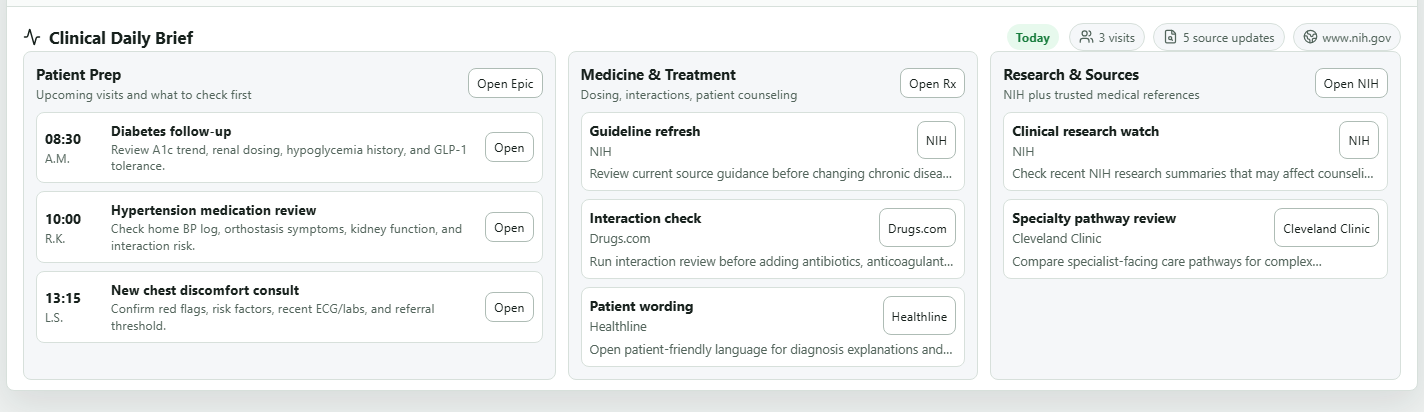
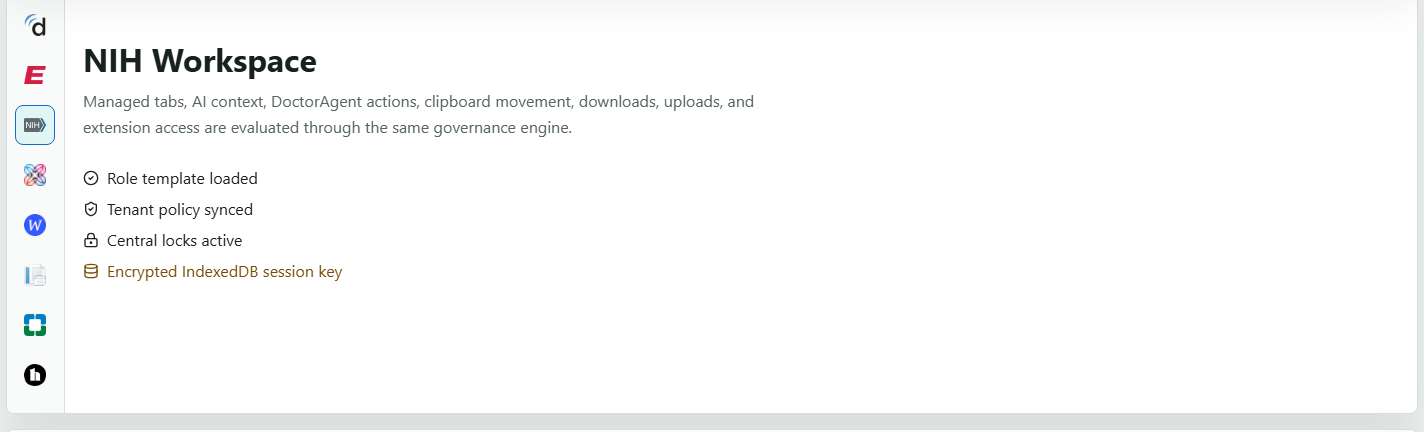
Real screens from the Mira clinical package
Not mockups — the actual Mira clinical build, governed end to end.
Clinical capabilities, governed
Approved medical workspaces
Fast access to leading clinical reference sites, drug databases, public-health authorities, clinician networks, your EHR portal and your own approved sources.
Specialist reviewers
Pharmacology, differential diagnosis, patient safety and evidence reviewers plus diagnostic and source-quality critics.
PHI / PII / ePHI detection
Warns or blocks when patient-identifying data appears in selected or visible context, enforcing no-send policy before model calls.
Stable answer format
Source basis, clinical assessment, safety and contraindications, missing data and confidence — easy to train, audit and compare.
Visible-context inspector
Clinicians and admins can see exactly what context the model is allowed to receive before sensitive use.
Department packages
Primary care, emergency, pharmacy & medication safety, residency education, and clinical quality / evidence review.
From the floor to the formulary
Repeatable, reviewable AI support across clinical workflows — always source-aware and audit-ready.
- Medication safety checksContraindications, interactions, renal/hepatic considerations and adverse effects on approved pharmacology sources.
- Differential diagnosis supportRed flags, workup, risk stratification and dangerous alternatives — challenging premature closure.
- Evidence reviewSeparate opened-page facts from inference, and challenge weak, stale or unsupported sources.
- Residency & educationStructured, citable answers that reinforce good clinical reasoning for trainees.
Trusted apps for this role
Mapped to your obligations
Questions for Healthcare teams
Does the AI see patient data (PHI)?
Can it answer outside approved medical sources?
How do we roll it out without disruption?
Bring governed clinical AI to your team
See Mira answer real clinical questions on approved sources — with PHI controls and confidence scoring — in a 30-minute demo.