
A governed, agent-native browser core
Mira turns the browser into a controlled operating layer for SaaS work. The same surface serves people and AI agents — with policy, identity, data protection and audit enforced in the core.
This page goes deep for technical and security reviewers. The short version: Mira is a browser your team installs, with security policy and AI built into the core — so people and AI agents do real work across your SaaS apps under the same rules, with full audit. Prefer the non-technical tour? Read “What is Mira?”
Five first-class product priorities
Not afterthoughts — a fast, resilient core; defense-in-depth security; deep observability; and safety rails on every human and agent action.
Performance
A fast, resilient core engineered in Rust for the next-generation browser and a hardened action boundary.
Robustness
Deterministic, structured automation that doesn't break when a page repaints — no brittle pixel-hunting.
Security
Defense-in-depth: sandboxed shell, typed IPC, fail-closed policy, DLP and prompt-injection protection.
Observability
Every human and agent action is traced intent → targets → decision → outcome, streamable to SIEM.
Safety
Plan → approve → execute gates, high-risk approvals and a panic stop on every agent workflow.
AI agents as first-class operators on real SaaS
No screenshots, no vision guesswork. Agents read a structured, semantic model of the live page and take typed, policy-checked actions — built for the agentic era.
- Structured page modelAgents read the DOM + accessibility tree, not screenshots — faster, deterministic and robust.
- A2A + WebMCP interfaceOpen agent-to-agent and Web Model Context Protocol contracts let agents discover and act through typed calls.
- One agent per tabIsolated agent sessions run in parallel across many sites and monitors — tear tabs into separate windows.
- Spaces + generative UIIn-built chat assembles pages, tools and workflows from a vetted, sandboxed component catalog — never arbitrary code.
- Controlled LLM trafficEvery model call routes through a pluggable gateway — third-party LLM providers or any OpenAI-compatible endpoint — with per-tenant routing, budgets and audit. (In short: you choose which AI provider is used, and stay in control of cost and data.)
- Automations, natural-language, agent-drivenDescribe a task in plain language; Mira plans and executes multi-step workflows across tabs. Record, parameterize, schedule and replay.
Fail-closed policy on every action
Browser-level governance with central control. If config can't be verified, access is denied; cached access expires via TTL.
- Browser action policyGovern navigation, downloads, uploads, clipboard, AI reads and WebAgent runs — fail-closed.
- RBAC + ABACDifferent access by role, team, specialty, workspace or attribute. Central locks stop policy loosening.
- Signed config bundlesVersioned, signed policy is the single source of truth, with drift detection and change approvals.
- Kill switch & time travelDrop a user, role, device or tenant instantly; roll config, Spaces and automations back to a known-good state.
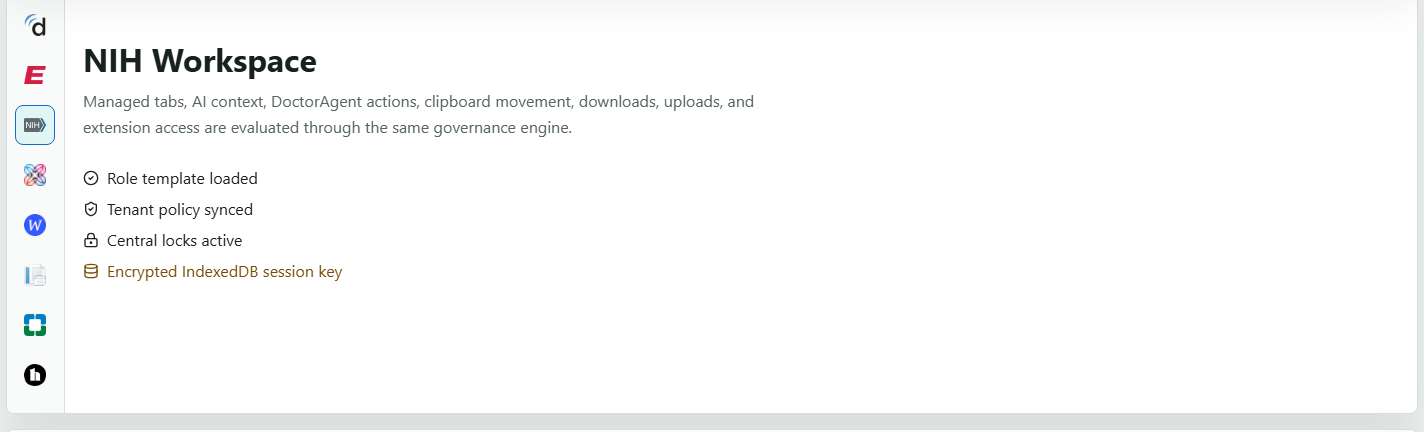
Source-level safety, built in
PII detection, prompt-injection protection, secret/DLP redaction and output validation run in the core — before context ever leaves the device or drives an action. Not an external add-on.
- PII/PHI detection at sourceSensitive data is detected and redacted before it ever leaves the device for a provider.
- Prompt-injection protectionHostile instructions inside untrusted page content are neutralized before they can drive an action.
- Encrypted hybrid local storageOne encrypted layer for human session data and agent memory — encrypted SQLite + vector store, OS-wrapped keys, TTLs.
- Visible-context inspectorUsers and admins can verify exactly what context the model is allowed to receive — before sensitive use.
Replace legacy VDI & VPN for browser work
Built-in ZTNA makes the browser itself the secure access layer — identity-bound, least-privilege, no endpoint to manage.
- Identity-aware brokerReach corporate apps without a flat VPN tunnel or a virtual desktop image.
- OAuth / SSO / MFAEnterprise identity providers; SAML/OIDC, SCIM provisioning, LDAP and enterprise directory integration.
- Built-in secure vaultSave passwords locally in an encrypted, OS-wrapped vault with policy-controlled autofill.
- SASE integrationRun alongside an existing enterprise SASE estate, or stand alone. Least privilege by app.
Open, pluggable, cross-platform
An installable browser that behaves like a true top-level browser — even for SaaS sites that reject iframes.
| Layer | Technology |
|---|---|
| UI | React 19 · TypeScript · Vite |
| Desktop core | Electron today → Tauri + Rust core (roadmap) |
| Browser core | Chromium WebContentsView / CEF — real top-level tabs |
| AI memory | Hybrid IndexedDB + ChromaDB vector store — encrypted local memory for AI, TLS/auth scoped |
| LLM gateway | Third-party LLM providers · OpenAI-compatible |
| Platforms | Windows · macOS · Linux (Android adapter next) |
See the platform on your own SaaS stack
We'll wire Mira to your real apps, agents and policy in a live walkthrough.